Loading...

What is Kosmic Kabbalah Art?

The word 'cosmos' refers to the physical universe seen as an orderly harmonious Whole.  The original Greek word 'Kosmos' however, refers to the Whole of all existence - in all realms - physical, emotional, mental and spiritual. The Hebrew word Kabbalah refers to the ancient mystical teachings that describe the Kosmos as an orderly harmonious Whole.

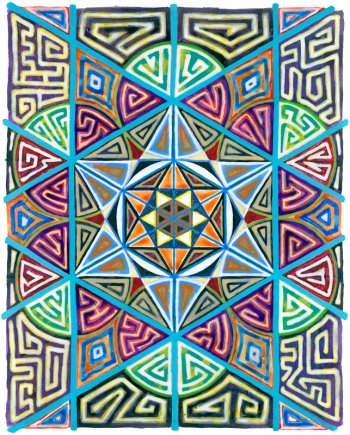
The teachings and much of the artwork presented on this site deal with Kosmic themes that are based on the Kabbalah:  Infinity, Eternity, Kosmogeny, Holy Names, Mandalas,  Sacred Geometry, Fractals, and Sefirotic Maps of the Kosmos (Tree of Life Diagrams).


All of the Giclee prints on canvas as well as all the prints on paper are hand-signed.  The canvas prints can be stretched and framed without glass.  The paper prints should be framed with glass.

There are some new pictures that are only now available as Giclee prints on canvas.  To view them go to 'New Works' under the 'Artworks by Subject' heading.


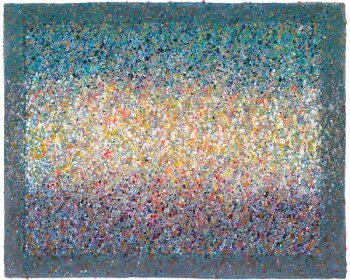
This is an imaginary landscape I made with many layers of watered-down acrylic paint.  It has the feeling of a pastoral scene here in the Galilee, and the choice of colors was definitely influenced by the local landscape.  There are no hidden symbols and nothing Kabbalistic here. 
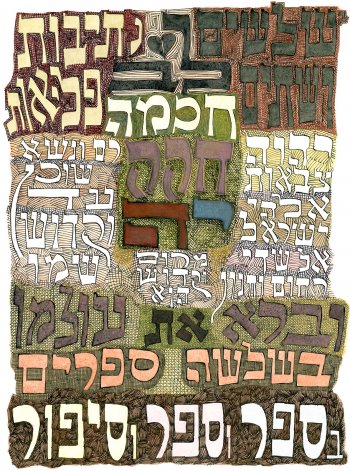
This picture contains the first words of Sefer Yetzirah:  “With 32 Wondrous Paths of Wisdom, Yah -  YHVH and Hosts, the God of Israel, El Shadai, Merciful and Gracious, High and Exalted, Dwelling Forever and Holy is His Name, Heavenly and Holy is He - engraved and created His Universe with three Sefarim: with Sefer, with Sefar and with Sippur.” In Hebrew, Sefer ספר is a book -… more
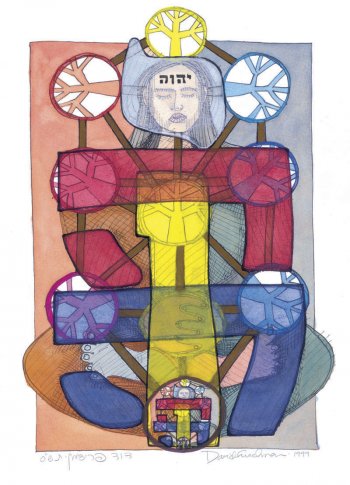
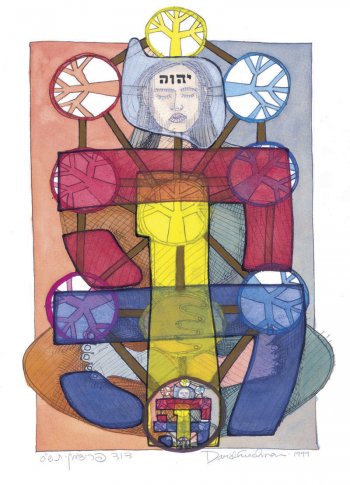
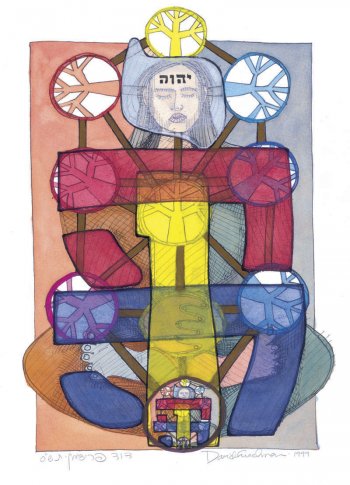
Rabbi Isaac Luria (known as the Ari) described the Ten Sefirot in great detail in a way known as Partzufim (Faces of God).  This how Prophets and Kabbalists see God in their own likeness and form.  And since humans come in many forms - Masculine and Feminine, Young and Old - the Partzufim are seen in all of these forms.  In this picture, the blue square symbolizes the… more
In the Passover song ‘Who Knows One?’, when we answer “God is One in Heaven and Earth” we mean that God is both transcendent (unknowable and so far beyond us) and  immanent (right here within us) at the same time.  Really, these are not two different things.  Transcendent God (in Heaven) and Immanent God (in Earth) is One.  A good word for this is non-dual.  The red ש… more
There is a small grove of ancient olive trees outside of Zefat.  It is about a fifteen-minute walk from my house, after two or three hairpin turns on the dirt road that goes down to Wadi Amud.  I used to like to sit in this grove surrounded by these ancient trees and meditate or study Kabbalah.  These trees were certainly here when Rabbi Isaac Luria was in Zefat in the 16th Century… more
I painted this picture not long after I made 'The Orchard of the Torah'.  I wrote the 4 letters of the Hebrew word for orchard פרדס (pardes) along the horizontal line dividing the picture in half.  4 pairs of trees representing the 4 levels of the Torah expressed by the 4 letters of Pardes - פשט - רמז -  דרש - סוד - simple, hinted, derived and secret.draw the eye inward to… more
The idea non-duality is found in many spiritual traditions.  In this picture I fused the Hebrew letter א Aleph with the Chinese Yin-Yang symbol.  Both symbols represent non-duality or the unification of opposites:  Heaven and Earth, Hot and Cold, Masculine and Feminine, Outside and Inside, etc. The small circles inside both halves represent how there is Feminine is the Masculine;… more
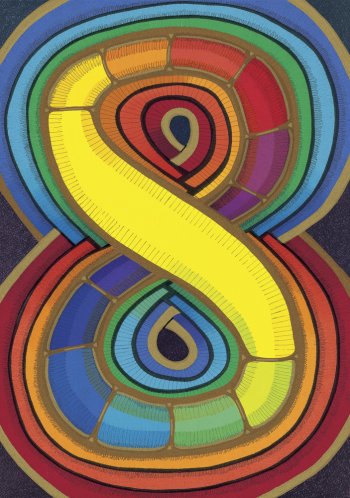
The number 8 in the Kabbalah represents the Infinite and Eternal realm that is beyond - and within - our Soul, Time, and Space. The figure 8, when placed on its side, is the mathematical symbol for Infinity.  It is also reminiscent of a Möbius strip, a shape with a surface that only has one side - its inside and outside are one!  It can be constructed by affixing the ends of a… more

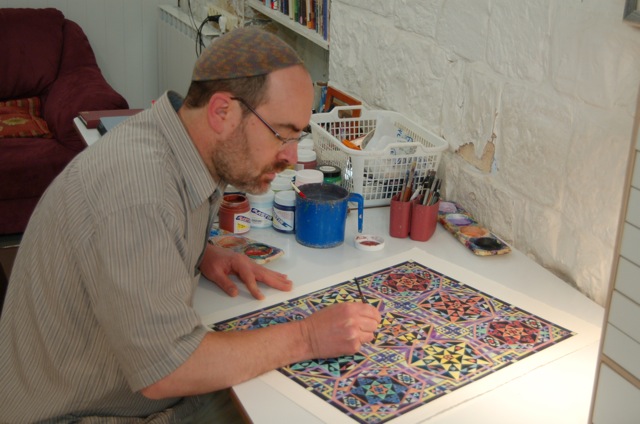
THE ARTIST DAVID FRIEDMAN

I immigrated to Israel in 1977 at the age of 20, and spent two years studying Torah in Jerusalem, where I met my wife, Miriam. We got married in 1979 and moved to Zefat.

In Zefat, I mostly immersed myself in the study of the Talmud and other classic texts of Judaism as well as Kabbalah, but I continued to make art at night. 
READ DAVID'S STORY

latest teachings

Sefer Yetzirah Motherboard
Sefer Yetzirah
|

Since the ancient classic Sefer Yetzirah (Book of Creation) inspires much of the art that is shown on this site, I feel that is

Read More
Meditating on the Holy Name
The Third Temple
|

In the Torah, God commanded the Children of Israel to build a tabernacle, a Mishkan, a dwelling place for His Presence, the Shechinah.  God

Read More

FIND US
Call Us

+972 54 2027832

Address

38 Bar-Yochai Street, Safed, Israel  

Open the map
Close the map