Loading...

What is Kosmic Kabbalah Art?

The word 'cosmos' refers to the physical universe seen as an orderly harmonious Whole.  The original Greek word 'Kosmos' however, refers to the Whole of all existence - in all realms - physical, emotional, mental and spiritual. The Hebrew word Kabbalah refers to the ancient mystical teachings that describe the Kosmos as an orderly harmonious Whole.

The teachings and much of the artwork presented on this site deal with Kosmic themes that are based on the Kabbalah:  Infinity, Eternity, Kosmogeny, Holy Names, Mandalas,  Sacred Geometry, Fractals, and Sefirotic Maps of the Kosmos (Tree of Life Diagrams).


All of the Giclee prints on canvas as well as all the prints on paper are hand-signed.  The canvas prints can be stretched and framed without glass.  The paper prints should be framed with glass.

There are some new pictures that are only now available as Giclee prints on canvas.  To view them go to 'New Works' under the 'Artworks by Subject' heading.


The idea non-duality is found in many spiritual traditions.  In this picture I fused the Hebrew letter א Aleph with the Chinese Yin-Yang symbol.  Both symbols represent non-duality or the unification of opposites:  Heaven and Earth, Hot and Cold, Masculine and Feminine, Outside and Inside, etc. The small circles inside both halves represent how there is Feminine is the Masculine;… more
Some people see this picture as stars in space, but I see it as subatomic particles, quanta.  That is why I named it Quantum Uncertainty. According to the Kabbalah, everything created  - whether large or small is relative and subjective.  Only God is Absolute and Unlimited.  Even the totality of Space is 'tiny' compared to the Divine Infinity; and even the particles that… more
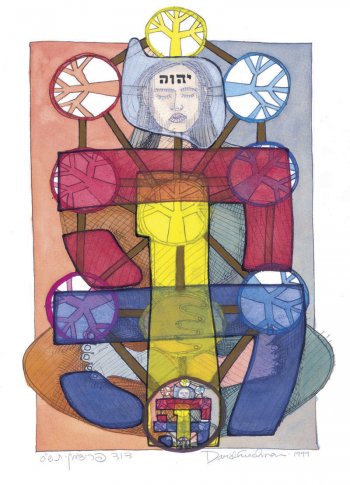
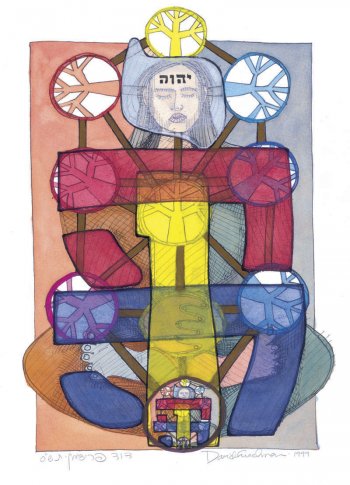
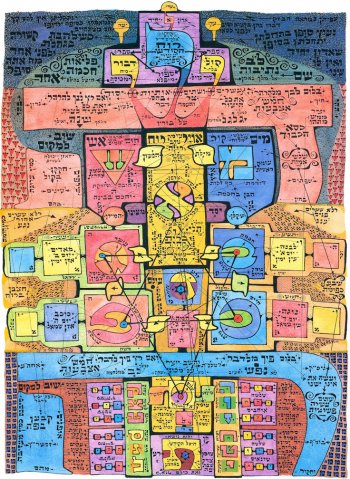
In Sefer Yetzirah the 10 Sefirot are always referred to as Sefirot of Nothingness בלימה (blimah).  Unlike the 22 Letters which can be expressed in speech, the10 Sefirot are conceptual, perceived in the mind.  And so are numbers. This image depicts the 10 Sefirot  as a Tree of Life Diagram with 3 vertical columns.  It representsthe human form as a reflection of the Divine.… more
Albert Einstein said “Science without Religion is lame, and Religion without Science is blind.”  The Kabbalists have always seen the two as complementary rather than contradictory.  The cosmology of Kabbalah and of Modern Science can also be seen as complementary perspectives. In the Kabbalah, the Creation of the Universe is spoken of as a contraction of God’s  Infinite Light.… more
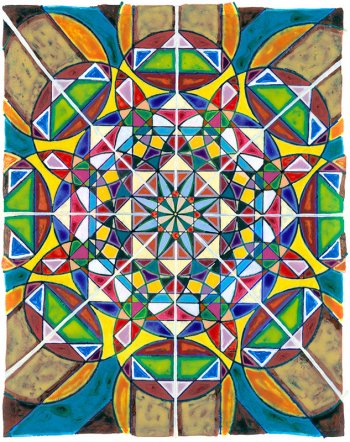
This Geometric picture is based on the number 6.  A bright orange 6-pointed Star of David (Magen David) is embedded in the central circle.  A smaller white Magen David is embedded in the hexagon that is the center of the orange Star.  The hexagon at the center of that white Magen David can be seen as a cube.  This motif is similar to the one I used in my picture 'The Holy… more
Life is a dynamic process of balancing between hot and cold; activity and rest;  nature and nurture.  Balancing between what we keep private and what we share with others; and between many other complementary pairs of opposites.  The lower half of this picture shows the circular Root System of this Tree of Life.  The 10 concentric Roots and the Seed relate to the tenth… more
Rabbi Isaac Luria (known as the Ari) described the Ten Sefirot in great detail in a way known as Partzufim (Faces of God).  This how Prophets and Kabbalists see God in their own likeness and form.  And since humans come in many forms - Masculine and Feminine, Young and Old - the Partzufim are seen in all of these forms.  In this picture, the blue square symbolizes the… more
In Genesis, God created Adam "in His own Image, in His own Likeness".   However, since we believe that God has no image or likeness, Kabbalists understand this as saying that God makes Himself known to us in our likeness by ‘clothing’ Himself in the 10 Sefirot of Adam Kadmon - associated with the 4 Letters of the Name of God יהוה (YHVH). The 4 Holy Names in this 'Tapestry' are the… more

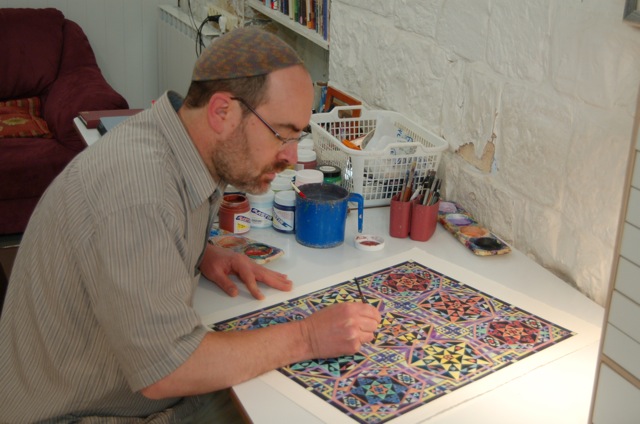
THE ARTIST DAVID FRIEDMAN

I immigrated to Israel in 1977 at the age of 20, and spent two years studying Torah in Jerusalem, where I met my wife, Miriam. We got married in 1979 and moved to Zefat.

In Zefat, I mostly immersed myself in the study of the Talmud and other classic texts of Judaism as well as Kabbalah, but I continued to make art at night. 
READ DAVID'S STORY

latest teachings

Sefer Yetzirah Motherboard
Sefer Yetzirah
|

Since the ancient classic Sefer Yetzirah (Book of Creation) inspires much of the art that is shown on this site, I feel that is

Read More
Meditating on the Holy Name
The Third Temple
|

In the Torah, God commanded the Children of Israel to build a tabernacle, a Mishkan, a dwelling place for His Presence, the Shechinah.  God

Read More

FIND US
Call Us

+972 54 2027832

Address

38 Bar-Yochai Street, Safed, Israel  

Open the map
Close the map