Loading...

What is Kosmic Kabbalah Art?

The word 'cosmos' refers to the physical universe seen as an orderly harmonious Whole.  The original Greek word 'Kosmos' however, refers to the Whole of all existence - in all realms - physical, emotional, mental and spiritual. The Hebrew word Kabbalah refers to the ancient mystical teachings that describe the Kosmos as an orderly harmonious Whole.

The teachings and much of the artwork presented on this site deal with Kosmic themes that are based on the Kabbalah:  Infinity, Eternity, Kosmogeny, Holy Names, Mandalas,  Sacred Geometry, Fractals, and Sefirotic Maps of the Kosmos (Tree of Life Diagrams).


All of the Giclee prints on canvas as well as all the prints on paper are hand-signed.  The canvas prints can be stretched and framed without glass.  The paper prints should be framed with glass.

There are some new pictures that are only now available as Giclee prints on canvas.  To view them go to 'New Works' under the 'Artworks by Subject' heading.


There is a small grove of ancient olive trees outside of Zefat.  It is about a fifteen-minute walk from my house, after two or three hairpin turns on the dirt road that goes down to Wadi Amud.  I used to like to sit in this grove surrounded by these ancient trees and meditate or study Kabbalah.  These trees were certainly here when Rabbi Isaac Luria was in Zefat in the 16th Century… more
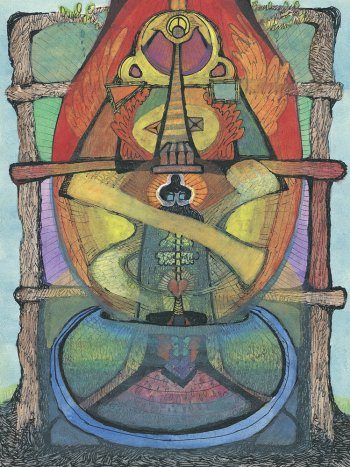
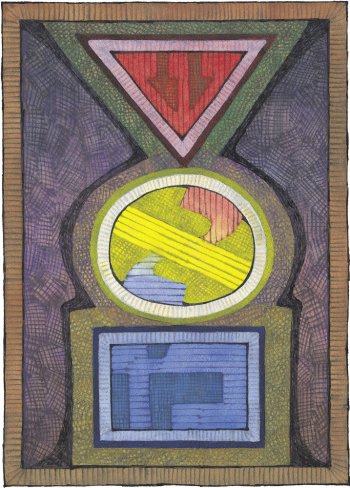
The red Shin ש represents Fire אש (aiSh) in Hebrew, thus, it rises up like fire;  the blue Mem מ represents Water מים (MahyiM) in Hebrew, thus, it flows downward like water.  The sounds of these 2 Letters are also opposites -  the outward hissing of Shhh.... and the inward humming of Mmmm... The yellow  between them also surrounds them both.  It represents the… more
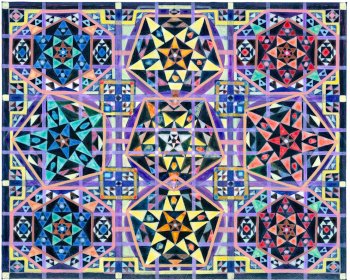
This pictures looks like something one might see under a microscope, thus the title - Microkosmic.  To me it looks like cells that have a fractal nature - self-similar but in different sizes.  Some of the cells also contain several smaller self-similar cells.  The round shapes also evoke a coronavirus, that is challenging our planet in 2020.
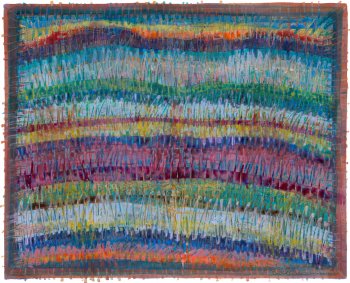
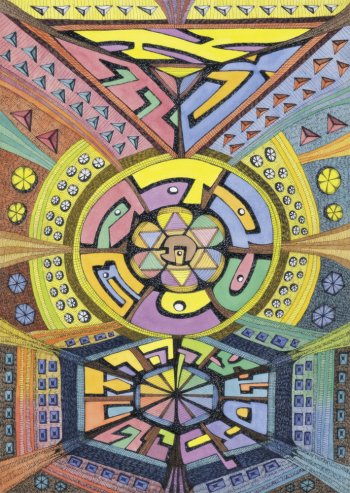
In this picture is the entire first chapter of the Book of Psalms. It begins in the center and continues counterclockwise outwards.  It is quite hard to read even for fluent Hebrew speakers because the letters flow into each other.  It is inspired by the lettering found on 60's album covers and concert posters. "Fortunate is the man who does not walk in the counsel of the wicked, nor… more
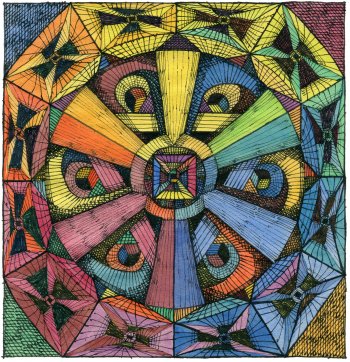
"10 Sefirot of Nothingness: Their end is embedded in their beginning and their beginning is embedded in their end like a flame tied to a burning coal For the Master is Singular, He has no second and before One what do you count?" (Sefer Yetzirah)   A common meditative technique in the Kabbalah is to contemplate the flame of a burning lamp.  Our soul is likened to the energy of the… more
When the Sefirot are presented in the Tanya (the classic text from the first Lubavitcher Rebbe) they are called 3 Mothers and 7 Doubles.  The 3 Mothers refer to the three higher Sefirot.  The Seven Doubles refer to the seven lower Sefirot. However, the original source of the terms Three Mothers and Seven Doubles is the Sefer Yetzirah, where the 22 Hebrew Letters are presented as three… more
I made this Tree of Life Diagram diagonal to hint at the shape of the first Letter א Aleph.  The 11th Sefirah, Daat, has a black dot to make it stand out, because it is the interface between the 3 higher Sefirot associated with the mind, and the 7 lower ones associated with the body. The Sefirot are spoken of as emanations of God's Light.  א Aleph is the first letter of the Hebrew word… more
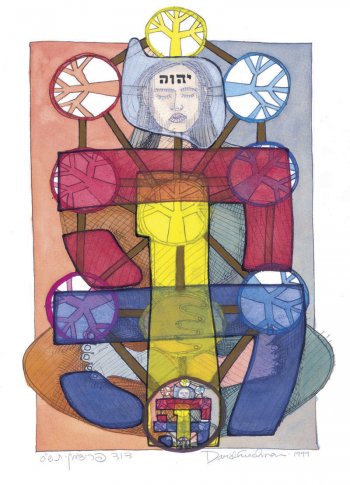
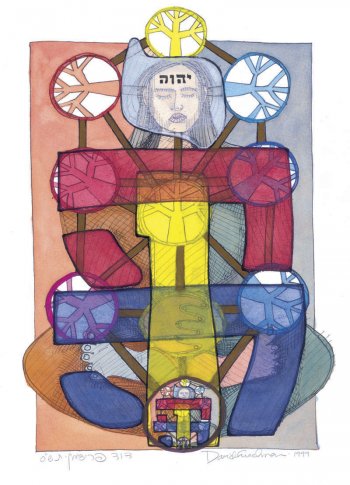
In Sefer Yetzirah the 10 Sefirot are always referred to as Sefirot of Nothingness בלימה (blimah).  Unlike the 22 Letters which can be expressed in speech, the10 Sefirot are conceptual, perceived in the mind.  And so are numbers. This image depicts the 10 Sefirot  as a Tree of Life Diagram with 3 vertical columns.  It representsthe human form as a reflection of the Divine.… more

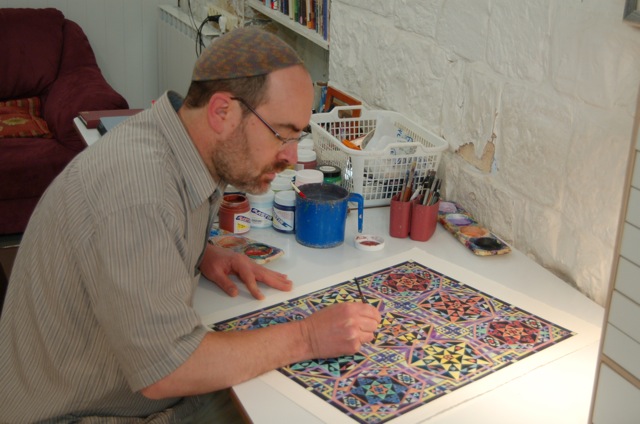
THE ARTIST DAVID FRIEDMAN

I immigrated to Israel in 1977 at the age of 20, and spent two years studying Torah in Jerusalem, where I met my wife, Miriam. We got married in 1979 and moved to Zefat.

In Zefat, I mostly immersed myself in the study of the Talmud and other classic texts of Judaism as well as Kabbalah, but I continued to make art at night. 
READ DAVID'S STORY

latest teachings

Sefer Yetzirah Motherboard
Sefer Yetzirah
|

Since the ancient classic Sefer Yetzirah (Book of Creation) inspires much of the art that is shown on this site, I feel that is

Read More
Meditating on the Holy Name
The Third Temple
|

In the Torah, God commanded the Children of Israel to build a tabernacle, a Mishkan, a dwelling place for His Presence, the Shechinah.  God

Read More

FIND US
Call Us

+972 54 2027832

Address

38 Bar-Yochai Street, Safed, Israel  

Open the map
Close the map