Loading...

What is Kosmic Kabbalah Art?

The word 'cosmos' refers to the physical universe seen as an orderly harmonious Whole.  The original Greek word 'Kosmos' however, refers to the Whole of all existence - in all realms - physical, emotional, mental and spiritual. The Hebrew word Kabbalah refers to the ancient mystical teachings that describe the Kosmos as an orderly harmonious Whole.

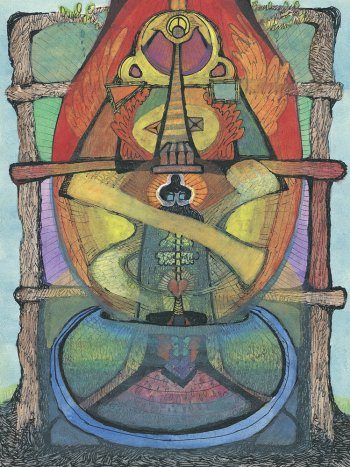
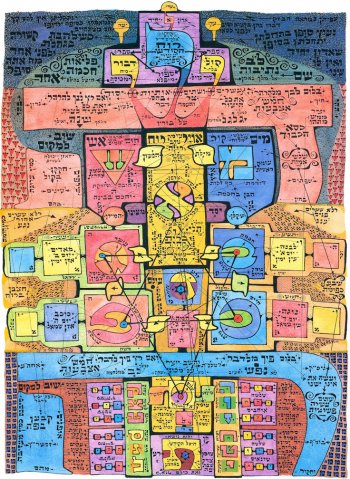
The teachings and much of the artwork presented on this site deal with Kosmic themes that are based on the Kabbalah:  Infinity, Eternity, Kosmogeny, Holy Names, Mandalas,  Sacred Geometry, Fractals, and Sefirotic Maps of the Kosmos (Tree of Life Diagrams).


All of the Giclee prints on canvas as well as all the prints on paper are hand-signed.  The canvas prints can be stretched and framed without glass.  The paper prints should be framed with glass.

There are some new pictures that are only now available as Giclee prints on canvas.  To view them go to 'New Works' under the 'Artworks by Subject' heading.


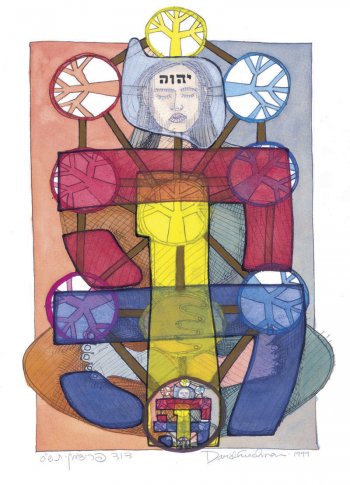
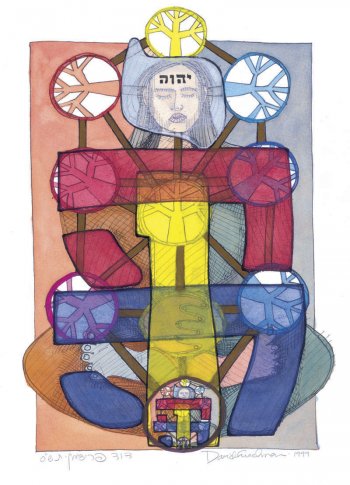
Rabbi Isaac Luria (known as the Ari) described the Ten Sefirot in great detail in a way known as Partzufim (Faces of God).  This how Prophets and Kabbalists see God in their own likeness and form.  And since humans come in many forms - Masculine and Feminine, Young and Old - the Partzufim are seen in all of these forms.  In this picture, the blue square symbolizes the… more
The Sages of the Talmud taught that there are 3 partners in the creation of every human being:  A father who gives the ‘white’ parts of the body; a mother who gives the ‘red’ parts; and God - who is present in the union of the two parents - and who gives us our consciousness, our 5 senses and our Soul.   This whole picture can be seen as just one figure, a Grandfather סבא (associated… more
This is a recent abstract painting of mine, acrylic on paper.  I like the play of colors here as well as the feeling of movement and energy. Many of my pictures are about light and colors - which are vibrations of light.  The entire spectrum of visible light is just a small part of electromagnetism which is spoken of in science as electromagnetic 'fields'.  This picture has the… more
Psalm 107, called the Psalm of Thanksgiving, describes four perilous situations that could befall us.  It tells us that someone who has gone through any of these situations and survived has a special obligation to give thanks and praise to God.  There is even a special blessings to say in the synagogue when called to the Torah.   The perilous situations described in Psalm 107 are:… more
The Abuhav Synagogue is one of the most beautiful synagogues in Safed. Rabbi Yitzchak Abuhav was a leader of the Spanish Jewish community expelled from Spain in 1492.  He died on his way to the Holy Land.  The synagogue was built by his students to house his personal Torah scroll which is still read three times a year. A legend claims that this synagogue was actually built in Spain… more
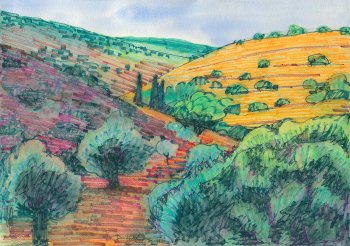
This is an imaginary landscape I made with many layers of watered-down acrylic paint.  It has the feeling of a pastoral scene here in the Galilee, and the choice of colors was definitely influenced by the local landscape.  There are no hidden symbols and nothing Kabbalistic here. 
"The Root of all religious observance and spiritual practice is for us to be constantly aware of God.  It should make us realize that we were created for the singular purpose of consciously experiencing the Creator.  Observance and practice should help us see that the only reason we were brought into the world is to use our spiritual powers to overcome our material attachments and… more
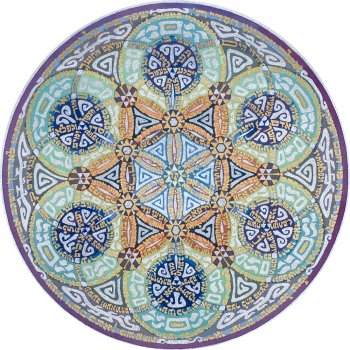
One of the most complex meditative techniques of the Kabbalah uses the 72 three-letter Names of God in this picture.  These 216 letters (72 x 3 = 216) actually comprise One Name. This Name is mentioned in the Bahir and the Zohar, in Rashi’s commentary on the Talmud, but it was Rabbi Abraham Abulafia, the controversial 13th Century Kabbalist, who taught how to use this Name in order to attain… more

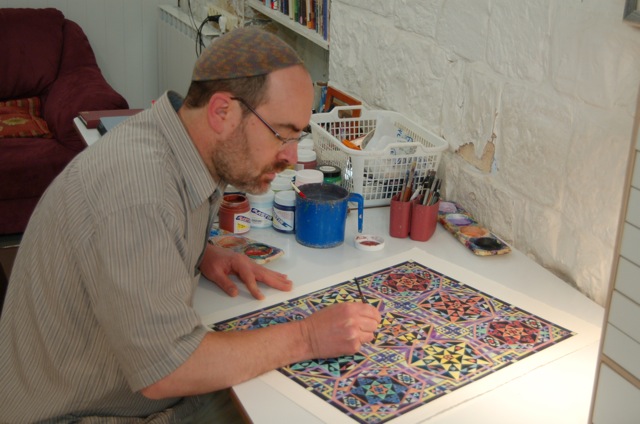
THE ARTIST DAVID FRIEDMAN

I immigrated to Israel in 1977 at the age of 20, and spent two years studying Torah in Jerusalem, where I met my wife, Miriam. We got married in 1979 and moved to Zefat.

In Zefat, I mostly immersed myself in the study of the Talmud and other classic texts of Judaism as well as Kabbalah, but I continued to make art at night. 
READ DAVID'S STORY

latest teachings

Sefer Yetzirah Motherboard
Sefer Yetzirah
|

Since the ancient classic Sefer Yetzirah (Book of Creation) inspires much of the art that is shown on this site, I feel that is

Read More
Meditating on the Holy Name
The Third Temple
|

In the Torah, God commanded the Children of Israel to build a tabernacle, a Mishkan, a dwelling place for His Presence, the Shechinah.  God

Read More

FIND US
Call Us

+972 54 2027832

Address

38 Bar-Yochai Street, Safed, Israel  

Open the map
Close the map